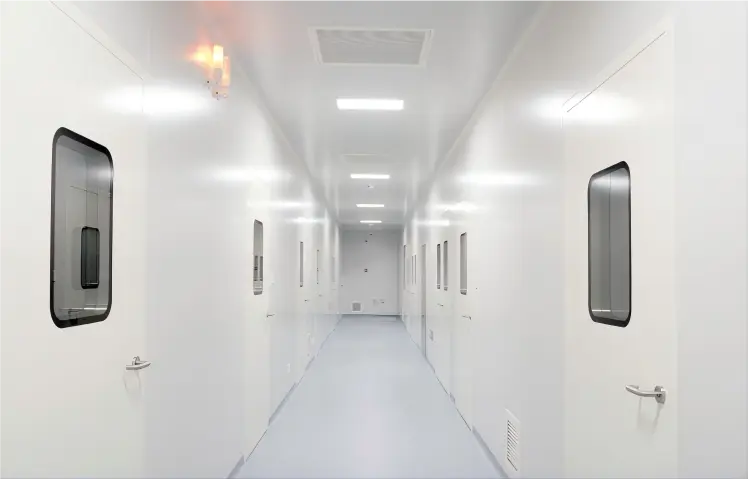
There is no single best core material for every cleanroom project. Rock wool is usually considered when fire performance is the top priority, while PIR is usually considered when thermal insulation and lightweight construction matter more. The right choice depends on your fire requirements, insulation targets, full panel construction and operating environment, and it should always be confirmed with test documents for the specific panel build-up you plan to buy.
This guide explains how the two cores differ, when each one fits, what to check for pharmaceutical, food and electronics projects, and what information to send your supplier so the quotation matches your project.
Key Takeaways
- Choose the core by project requirements, not by material name alone.
- Fire and thermal performance belong to the complete panel (core, facings, thickness, joints), not just the core.
- A panel does not create a cleanroom class by itself. Air handling, filtration, sealing and construction quality determine the room’s cleanliness level.
- Unit price alone is a poor basis for comparison. Compare like-for-like specifications and documents.
- PU and PIR are related but not the same material. Do not treat them as interchangeable in a specification.
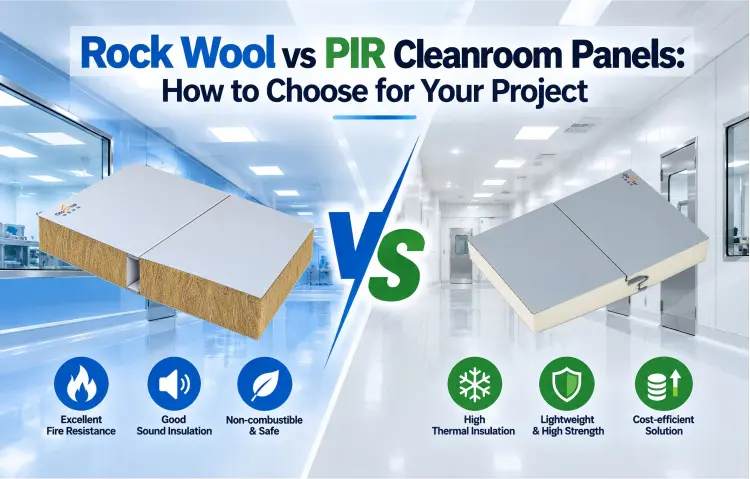
What Are Cleanroom Sandwich Panels?
Cleanroom sandwich panels are factory-made wall and ceiling panels with two metal facings bonded to an insulating core. The smooth, sealed facings support cleaning and help limit particle generation, while the core provides insulation, stiffness and, depending on the material, fire behavior. Two of the most common core options are rock wool and PIR (polyisocyanurate).
If you are already working on a project, see our Painel de parede para sala limpa e Painel de lã de rocha para salas limpas pages for available configurations.
Rock Wool vs PIR: Comparison Table
The table below is a qualitative guide. Exact values vary by manufacturer, density, thickness, facing and test standard, so always request documents for the specific panel you intend to use.
| Fator | Rock wool core | PIR core | What to verify |
|---|---|---|---|
| Fire performance | Mineral fiber core, commonly chosen for fire-focused projects | Rigid foam core, performance depends on tested panel construction | Fire test report for the complete panel build-up and the standard your project requires |
| Thermal insulation | Good insulation, but typically needs more thickness for the same target | Closed-cell foam, commonly chosen where insulation efficiency is a priority | Declared thermal performance at the stated thickness |
| Weight | Generally heavier | Generally lighter | Panel weight per square meter at the required thickness |
| Structural requirements | Heavier panels may need stronger support, ceiling hangers and span checks | Lighter panels can ease handling and support, subject to design | Allowable span, ceiling load and fixing details from the supplier |
| Cleanability | Determined mainly by facings, joints and sealing, not by the core | Determined mainly by facings, joints and sealing, not by the core | Facing material and coating, joint profile, sealing method |
| Cost drivers | Core density, thickness, facing, fire documentation, freight weight | Core grade, thickness, facing, documentation, freight volume | Quotation based on identical specifications |
When Rock Wool Cleanroom Panels Make Sense
Rock wool panels are typically considered when fire requirements drive the specification. This often applies to projects with strict local fire rules, higher-risk areas, or owner and insurer requirements for non-combustible construction.
Points to confirm before you specify rock wool:
- Complete panel build-up. The fire rating belongs to the tested assembly. Ask for the facing thickness, core density, panel thickness and joint design that the report covers.
- Test reports. Request reports that match the standard accepted in your project country.
- Weight and support. Heavier panels can affect ceiling systems, installation methods and shipping weight.
- Joint and edge sealing. Because fiber cores are not the cleaning surface, sealing and facing quality matter for the cleanroom environment.
For available options, see our Painel de lã de rocha para salas limpas page.
When PIR Cleanroom Panels Make Sense
PIR panels are typically considered when thermal performance, light weight and installation efficiency are the main concerns. This can apply to temperature-controlled rooms or projects where reducing wall thickness and structural load is valuable.
Points to confirm before you specify PIR:
- Project fire requirements. Check whether the PIR panel construction has test documents that satisfy the local requirement for your application.
- Thermal targets. Compare declared performance at the same thickness, not at different thicknesses.
- Test documents. Use data tied to a specific panel construction, not general material claims.
- Material naming. Confirm that the offered core is PIR and not a different foam. PU and PIR are not the same material, and their properties and documentation can differ.
Choosing by Industry
Avoid assuming that one industry always requires one core. Use the application to decide what to confirm.
Pharmaceutical projects. Confirm local GMP expectations, fire requirements, cleaning and disinfection routines, the facing coating’s chemical resistance, and how panels connect with doors, windows and HVAC penetrations.
Food and beverage projects. Confirm hygiene requirements, washdown frequency, humidity and temperature conditions, resistance to cleaning agents, and whether cold storage or temperature control affects the insulation requirement.
Electronics and precision manufacturing. Confirm the target cleanliness class, anti-static needs, ceiling and wall load for equipment, and fire requirements for the building and process area.
In each case, the final decision should combine the authority’s requirements, the owner’s standards and the engineering design.
Common Mistakes When Buying Cleanroom Panels
- Comparing only unit price. Two quotations are comparable only if core, density, thickness, facing material, coating and documents are the same.
- Choosing by core name only. “Rock wool” or “PIR” does not tell you the fire result, insulation value or durability of the finished panel.
- Treating panel performance as room cleanliness. A cleanroom class depends on filtration, airflow, pressure control, sealing and operating procedures, not only wall panels.
- Ignoring structural implications. Weight, span and ceiling loads should be checked early, especially for rock wool and for ceilings carrying equipment.
- Mixing up PU and PIR. Specify the exact core in your documents.
- Skipping documents until after the order. Request the relevant test reports and technical data before you confirm the order.
What to Send for an Accurate Quotation
To receive a quotation that fits your project, prepare the following:
- Project country and location
- Application (pharmaceutical, food, electronics or other)
- Approximate panel area and quantities for walls and ceilings
- Required panel thickness
- Facing material and coating requirements
- Fire-performance requirements and the standard they come from
- Thermal or temperature conditions
- Drawings or layout plans
- Required delivery time
The more complete this list is, the fewer revisions are needed and the faster the comparison can be made.
FAQ
Is rock wool or PIR better for cleanroom panels?
Neither is better in every case. Rock wool is usually considered when fire performance leads the requirements, and PIR when insulation and light weight matter more. The right answer depends on your project’s requirements and the documents for the specific panel.
Does the core material affect cleanroom cleanliness?
Mostly no. The cleaning surface is the metal facing, so cleanability depends on facing material, coating, joints and sealing. The room’s cleanliness class also depends on the HVAC and filtration system.
Are PU and PIR panels the same?
No. They are related foam materials but not identical, and their properties and test documents can differ. Specify the exact core in your inquiry.
Can I rely on a core’s fire rating alone?
No. Fire performance is tested on the complete panel construction, so check the report for the exact build-up you will buy.
Which is cheaper, rock wool or PIR?
It depends on density, thickness, facings, documentation, freight and market conditions. Compare quotations built on identical specifications.
What should I send to get a quotation?
Project country, application, area, thickness, facing requirements, fire and thermal requirements, drawings and delivery time.
Need Help Selecting Cleanroom Panels?
Send us your project drawings, panel quantities, fire-performance requirements and operating conditions. Our team can help review suitable panel configurations and prepare a project-based quotation.